Soils of Rajasthan
Subject: Rajasthan Geography
Review key revision formulas, common exam traps, and test your knowledge with targeted practice questions.
Detailed technical explanation
The uppermost layer of the land which provides minerals etc. necessary for the growth of trees and plants is called soil.
Different types of soil are found at different places. Their difference is related to the structure of the rocks there, surface form, climate, vegetation etc.
The science of study of soil is called soil science i.e. pedology.
Following are the common types of soil –
It is formed under specific conditions resulting from the gradual change of humidity and dryness of the monsoon climate. Deep laterite soil contains high amounts of iron oxide and potash. Due to the presence of iron oxide, almost all laterite soils are rust colored or reddish. This soil, formed by the breakdown of rocks, is classified as dark red laterite, white laterite and underground hydrological laterite. Laterite soil is best suited for tea cultivation.
It is formed by the erosion of granite and sandstone in areas of high temperature and low humidity.
It is formed by the disintegration and disintegration of clayey and metamorphic rocks due to water-air changes. This soil is rich in silica and iron. The red color of red soil is due to the presence of iron oxide, but in the hydrated form it appears yellow.
It is formed by the breakdown of basalt rocks. It is rich in iron, lime, aluminum trace elements and magnesium. The black color of this soil is due to the presence of titaniferous magnetite and organic matter (humus). This soil is also known as Regur soil. Black soil is most suitable for cotton cultivation, hence it is also called black cotton soil. Cotton, wheat, pulses and coarse grains are cultivated in this soil.
This is soil brought by rivers. This soil is rich in potash, but deficient in nitrogen, phosphorus and humus.
There are two types of soil:-
1.Bangar 2.Khadar
The old alluvial soil is called Bangar and the new alluvial soil is called Khadar.
Most of the soils of Rajasthan are alluvial and alluvial. Due to the dry climate here, the alluvial plains gradually turned into arid plains and the entire western region became sandy desert. The soils of western Rajasthan are generally sandy. Whereas the south-eastern plateau part is part of the Malwa plateau, where there is black and at some places red soil. Soil fertility in the state increases from west to east. Fertile soil is found in the valleys of Chambal, Banas, Mahi, Banganga, Luni and their tributaries.
Soil zones in Rajasthan are divided into 9 parts on the basis of their characteristics and fertility –
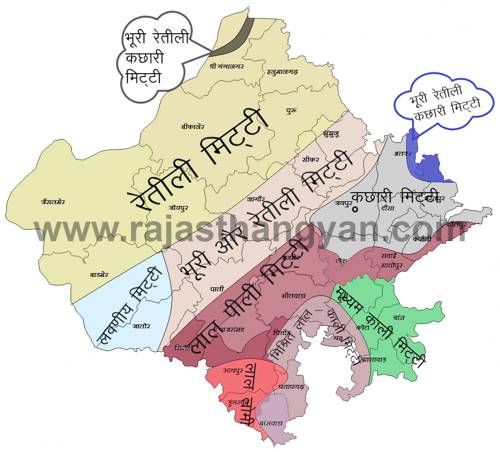
About 31.7 lakh hectares of land in India is sandy. In the north-western region of the Aravali, which is part of the Thar Desert, the soil is mostly sandy. The particles of this soil are coarse due to which its water holding capacity is low, it lacks nitrogen, organic salts and organic matter, but it has abundance of calcium salts. This entire area is made up of soil brought by the wind. It is suitable for millet, moth and moong crops.
Found in the western districts of Aravalli, Barmer, Jalore, Jodhparu, Sirohi, Pali, Nagaur, Sikar and Jhunjhunu districts. Phosphate elements are found in abundance in this soil.
The red and yellow color of these soils is due to the high degree of hydration of iron oxide. There is negligible calcium carbonate and deficiency of nitrogen and organic factors in it. This soil is found in Sawai Madhopur, Bhilwara, Ajmer and Sirohi districts. Chika and loam type soils are found in these parts. The PH value of this soil is between 5.5 to 8.5.
Its red color indicates the presence of iron elements in it. Since the particles of such soil are fine, water remains in it for a long time. It is deficient in nitrogen, phosphorus and calcium salts. And there is abundance of potash and iron elements. This soil is found in some parts of Dungarpur, Banswara, Udaipur and Chittorgarh of southern Rajasthan. By applying chemical fertilizers and irrigation in this type of soil, rice, cotton, maize, wheat, sugarcane etc. can be grown.
This is an extension of the black soil of the Malwa plateau. It generally lacks phosphate, nitrogen, calcium and organic matter. Generally it is a fertile soil in which crops like cotton, maize etc. are grown. This soil is found in Bhilwara, Chittorgarh, Dungarpur and Banswara and eastern parts of Udaipur.
The color of this soil is dark brown. This type of soil is formed from lava materials. Its particles are fine. Due to which its water holding capacity is high. These soils contain adequate amounts of phosphate, nitrogen and potash. This is fertile soil. Most suitable for cotton cultivation. For this reason it is also called regur and cotton soil. This soil is mainly found in Jhalawar, Bundi, Baran and Kota districts.
It is considered to be the most fertile soil brought by rivers. It has high water holding capacity. It contains nitrogen and organic salts in sufficient quantities. But there is deficiency of lime, phosphoric acid and organic matter (humus). It is suitable for wheat, rice, cotton and tobacco.
This type of soil has high amount of alkaline salts. It is infertile. It extends to Barmer, Jalore. Apart from this, it is also found in Ganganagar and Bikaner.
There is deficiency of lime, phosphorus and humus in it. It is fertile. It extends to the central part of Ganganagar, Alwar and northern part of Bharatpur.
This classification was given by Prof. Tharp and Smith presented –
Red sandy soil is mainly found in desert areas. The amount of nitrogen and organic elements in red sandy soil is less. Rainy grass and some bushes are found in areas with red sandy soil. In areas with red sandy soil, rainfed farming is done during the Kharif season, which is completely dependent on rainfall. In areas with red sandy soil, Rabi crops (wheat, barley, gram etc.) are grown only after applying chemical fertilizers and irrigation. Red sandy soil is found in some parts of Jalore, Jodhpur, Nagaur, Pali, Barmer, Churu and Jhunjhunu districts.
Deposits of brown soil are especially found in the flow areas of Banas and its tributaries. The brown soil area in Rajasthan is considered to be in the eastern part of Aravali. Brown soil lacks nitrogen and phosphorus salts. Brown soil is found in Tonk, Sawai Madhopur, Bundi, Bhilwara, Udaipur, Rajsamand and Chittorgarh districts of the state.
Yellow and brown soil is serozem. Serozam soil particles are of medium thickness. Serozam soil is deficient in nitrogen and organic matter. Fertility of serous soil also reduces. Rainfed farming is done in serozam soil. Rabi crops in serous soil require continuous irrigation and large amounts of chemical fertilizers. Expanses of serous soils are found mostly to the west of the Aravalis. Serozam soil is found in large areas in Pali, Nagaur, Ajmer and Jaipur districts. Serozam soil is found in areas with small dunes.
The particles of red loamy soil are fine. Due to the presence of water for a long time, moisture remains in the red loamy soil for a long time. The reason for red color of red loamy soil is the abundance of iron oxide. Red loam soil is deficient in nitrogen, phosphorus and calcium salts. By applying chemical fertilizers and irrigation in red loam soil, crops like cotton, wheat, barley, gram etc. grow well. Red loam soil is found in some parts of Dungarpur, Banswara, Udaipur, Rajsamand and Chittorgarh districts (Southern Rajasthan) of Rajasthan.
Sandy soil is found in western Rajasthan. The particles of sandy soil are coarse, in which water dissolves quickly. And irrigation also does not have much benefit. There is deficiency of nitrogen and organic salts in sandy soil. There is abundance of calcium salts in sandy soil. Kharif crops like millet, moth, moong etc. are grown in areas with sandy soil. Clay soil with fine particles is found at the bottom of high dunes of sandy soil. The lower areas of high dunes of sandy soil are called Khadin, they are very fertile.
Alluvial soil is formed on the banks of rivers and streams and in their flow areas. Alluvial soil is soil carried by rivers. Alluvial soil is very fertile. Alluvial soil contains nitrogen and organic salts in sufficient quantity. At some places in the alluvial soil, there is accumulation of pebbles, in which the amount of calcium elements increases. Both Kharif and Rabi crops can be grown in alluvial soil. Alluvial soil is found in the districts of Alwar, Jaipur, Ajmer, Tonk, Sawai Madhopur, Bharatpur and Dholpur, Kota etc.
Saline soil has more alkaline salt elements. Accumulation of salts in saline soil also occurs due to excessive irrigation. Saline soil is completely infertile. Only shrubs and rainy trees can grow in saline soil. Most of the areas of saline soil are found in western Rajasthan. Saline soil is found especially in Barmer and Jalore of Rajasthan and in irrigated areas like Sri Ganganagar, Hanumangarh, Bharatpur and Kota.
The color of mountain soil ranges from red to yellow to brown. Due to the mountain soil being on the hill slopes, the depth of the mountain soil is less, after some depth there is a rocky surface. Farming cannot be done on mountain soil. Mountain soil is found in the hilly parts of Sirohi, Udaipur, Pali, Ajmer and Alwar districts.
It has been the effort of scientists to create such a classification of soil in which all the soils of the world can be easily classified. For this, scientists of the US Department of Agriculture developed a new method. In this new method, importance is given to the factors of soil origin and the more important properties present in the soil are given.
According to this, classification of soils in Rajasthan -
In western Rajasthan. A soil category that includes soils located in different types of climates. This type of soil is found in almost all the districts of western Rajasthan. Its color is usually light yellow-brown
Mineral soil which is mostly found in dry climates. In Churu, Sikar, Jhunjhunu, Nagaur, Jodhpur, Pali, Jalore districts.
Area of black and regur soil. Due to presence of excessive clay in it, it has the characteristics of clayey soil. Jhalawar, Baran, Kota, Bundi
In semi-arid to humid climate areas. Also in plains with alluvial soils. Completely absent in dry climates. Sirohi, Pali, Rajsamand, Udaipur, Bhilwara, Jhalawar.
Area of alluvial soil. Jaipur, Dausa, Alwar, Bharatpur, Sawarimadhopur, Karauli, Tonk, Bhilwara, Chittorgarh, Banswara, Rajsamand, Udaipur, Dungarpur, Bundi, Kota, Baran, Jhalawar. High amount of clayey soil.
Jaipur – General Soil Laboratory. Jodhpur – Problematic Soil Laboratory. Central Soil Conservation Board office in the state – Kota, Jodhpur.
Red soil has more sand content. CaCO3 is not found in it. Such soil is generally neutral (pH value is 0-7.5).
In saline soil the pH value is less than 5.
The pH value of sandy soil is high (alkaline).
Generally, if the pH value of soil is less than 5, it is called acidic soil.
The most suitable soil pH value for plants is 6 to 7.
The most productive soils have a pH range of 6-8.
The movement of fertile soil from the upper surface of the soil is called soil erosion or soil erosion.
Gully erosion/river problem – Erosion of soil by water due to heavy rains which leads to formation of deep valleys and drains. Kota (mostly), Bundi, Dholpur, Bharatpur, Jaipur and Sawai Madhopur districts are suffering from this problem.
Layer erosion- blowing away of the upper layer of soil by wind.
Soil erosion is mainly caused by excessive grazing by animals, unscientific farming and indiscriminate cutting of forests.
Same problem/Excessive water – This problem is found in areas irrigated by canals.
Use of rock phosphate to overcome the problem of salinity in soil.
Use of gypsum to overcome the problem of alkalinity of soil.
The area of soil erosion by wind is the largest in the state, followed by soil erosion by water.
The channel erosion of soil is maximum from Chambal river.
Khadin- In the desert, low deep areas are formed at some places near high sand dunes. Due to which clayey soil with fine particles accumulates.
When the water in the pond dries up, the layer of fertile soil on the ground is called pana.
The maximum barren and uncultivated land in Rajasthan is in Udaipur.
Jaisalmer is at second place.
The first soil testing laboratory of the state was established in Jodhpur named Indian Alkaline Soil Testing Laboratory.
Same problem of land mainly in Hanumangarh, Sriganganagar district.
To solve Hanumangarh bean problem, EcoDutch project is being run with the help of Netherlands (Holland).
Netherlands is providing economic and technical assistance.
Green manure and cow dung should be used for barren land.
About 7.2 lakh hectares of land in Rajasthan is alkaline and saline.
Cover erosion – When due to heavy rains the soil of deserted hills gets dissolved in water and gets washed away.
Surface erosion – Washing away of the upper valuable soil of hill and surface slopes by water.
Corrugated erosion – When water flows. So its various streams cut the soil to some depth, as a result, drains several feet deep are formed in the surface. This type of erosion is found in Kota, Sawai Madhopur, Dholpur.
Dhamasa (Trophosia purpurea)—is a weed which is found mostly in Jaipur area.
20% of the country's waste land is found in Rajasthan, in terms of area the maximum waste land is in Jaisalmer (37.30%).
In terms of percentage of available area, the most wasted plateau land is in Rajsamand.
Start Quiz!
No practice questions available for this topic yet.