Article 214- There will be a High Court for each state.
7th amendment act 1956Parliament was empowered byHigh Court common to two or more States or Union TerritoriesCan also be formed.
Currently 25 in the countryhigh courtAre.
of the Indian ConstitutionPart 6 Chapter 5InFrom Article 214 to Article 232The provisions related to the organization and authority of the High Court of the states have been described. According to Article 214, there is a provision for a High Court in every state, butArticle 231According to this, Parliament can provide for a common High Court for two or more states.
Formation of High Court
of the constitutionArticle 216InFormation of High CourtIt is mentioned in it that every High Court shall consist of a Chief Justice and other Judges to be appointed by the President from time to time.
Unlike the Supreme Court, the number of other judges in the High Court is not fixed by the Constitution.
This is the reason why Sikkim has the least number of judges and Uttar Pradesh has the maximum number of judges.
The President has the right to appoint the acting Chief Justice under Article 223 of the Constitution and additional judges under Article 224.
appointment of judges
Article 217InAppointment of High Court judgesThere is provision for. The Chief Justice of the High Court will be appointed by the President in consultation with the Chief Justice of the Supreme Court and the Governor of that State. In the appointment of other judges of the High Courts, the President will take the advice of the Chief Justice of the Supreme Court, the Chief Justice of the High Court and the Governor of that State.
Ability
**Article 217(2)**The qualifications of High Court judges have been described.
He should be a citizen of India.
Must have held the post of judge in a subordinate court for at least 10 years or must have practiced law in any High Court for 10 consecutive years or must be an accomplished or reputed advocate in the eyes of the President.
There is no minimum age limit for becoming a judge or62 years oldHave not completed.
Oath (Article 219)
Before the Governor or any person appointed by the Governor.
Tenure
There is no fixed tenure of High Court judges in the Constitution. However, 4 provisions have been given in this regard -
- He holds office till the age of 62 years.
- Can submit his resignation to the President.
- The President (on the recommendation of Parliament) can remove him from office.
- On appointment to the Supreme Court or transfer to another High Court, he gives up his post in the present Court.
resignation letter
The Chief Justice and other judges submit their resignation to the President.
transfer
High Court judges can be transferred from one High Court to another by the President in consultation with the Chief Justice of the Supreme Court.
Salary and Allowances (Article 221)
Parliament has been given the power to determine the salaries and allowances of High Court judges. The Chief Justice of the High Court gets a salary of Rs 90,000 per month and other judges get a salary of Rs 80,000 per month.
Powers and jurisdiction of the High Court
At present the High Courts have the following powers -
- initial jurisdiction
- Appellate Jurisdiction
- Writ Jurisdiction
- Court of Records
- power of judicial review
- control over subordinate courts
- supervisory authority
1. Initial Jurisdiction
Those cases in which one can go directly to the High Court. Such cases are as follows –
Matters related to enforcement of fundamental rights.
Any matter before a subordinate court which involves a question of interpretation of the Constitution.
Disputes related to election of Members of Parliament and State Legislature members.
In revenue collection and other revenue matters.
In matters like marriage, divorce, will, company law etc.
Judicial contempt cases.
High Courts (four High Courts have original/original jurisdiction in civil cases - Calcutta, Bombay, Madras and Delhi High Courts)
Initially, the Calcutta, Bombay and Madras High Courts also had original jurisdiction in criminal cases, which was abolished by the Code of Criminal Procedure 1973.
2. Appellate Jurisdiction
The High Court is basically an appellate court, which hears appeals against the decisions of subordinate courts. It can hear appeals in both civil and criminal cases.
A. Appeal related to civil case
In cases where the amount exceeds the prescribed limit, an appeal can be made to the High Court against the decisions of all subordinate courts. Whether the matter is related to law or fact.
In case of a case involving a substantial question of law, an appeal can be made to the High Court against the decision of the District and Subordinate Court.
After 1997, the decisions of administrative and other tribunals were also brought under the appellate jurisdiction of the High Court. That is, in these cases the victim cannot directly approach the Supreme Court.
There is a system of inter-court appeal in the Calcutta, Bombay and Madras High Courts.
B. Appeal related to criminal case
In cases involving punishment of more than seven years, an appeal can be made to the High Court against the decision of the Sessions Court/Additional Sessions Court.
Death penalty cases must be confirmed by the High Court. Whether the victim has appealed or not.
An appeal can be made to the High Court against the decision of the Assistant Sessions Judge, Municipal Magistrate or other magistrate in those cases 'which are mentioned in the Code of Criminal Procedure 1973'.
3. Injunction or writ jurisdiction
Article 226High Court under**Writ for enforcement of fundamental rights and for ‘any other purpose’**Can issue (habeas corpus, mandamus, prohibition, certiorari, quo warranto), orders or directions.
**Note -**The writ/writ jurisdiction of the High Court is wider than that of the Supreme Court.
4. Court of Records (Article 215)
Like the Supreme Court, the High Courts also have the power to give punishment in cases related to record court and judicial contempt.
judicial contempt
The term judicial contempt is not defined in the Constitution.
It is defined in the Contempt of Judicial Act 1971.
There are two types of judicial contempt.
Civil Contempt – Willful disobedience to court orders.
Criminal contempt -
- Publishing such articles against the decision of the court which harm the honor of the court.
- Interference or obstruction in judicial proceedings.
- Creating obstruction/obstruction in judicial proceedings.
5. Power of judicial review
Like the Supreme Court (Article 13)**High Courts (Article 226)**Also has the power of judicial review.
6. Control over subordinate courts
High courts have extensive power of control over subordinate courts (such as district and below courts).
Just as the law declared by the Supreme Court is binding on all the courts of India. Similarly, the laws of the High Court are binding on all those subordinate courts which come under the jurisdiction of the High Court.
7. Supervisory powers
High Courts have the right to supervise the activities of all the courts and subsidiary courts falling under their jurisdiction.
This is an extraordinary power of the High Court but not unlimited.
The High Court exercises this power only when the subordinate courts do the following -
A. Encroachment on your jurisdiction.
B. Violation of natural justice.
S. Legal error or disrespect for law
removal of judges
To remove High Court judges, the same procedure is followed as is prescribed for Supreme Court judges. That is, these too can be removed only on two grounds -
- inability
- proven misconduct
Important articles related to High Court
**Article 214 -**There will be a High Court for the states.
**Article 215 -**Court of Records.
**Article 216 -**Formation of High Court.
**Article 217 -**Terms and conditions of appointment and post.
**Article 219 -**Oath or affirmation.
Provisions regarding independence of High Courts
Method of appointment.
security of tenure.
Fixed Terms of Service.
Salary, allowances etc. charged on accumulated fund.
There is no discussion on the actions of judges in Parliament or State Legislature.
Power to punish for judicial contempt.
Power to appoint its employees.
Their jurisdiction cannot be curtailed.
Separation from the executive.
In Part 6 of the ConstitutionArticle 233 to 237 Organization of Subordinate CourtsAnd provisions related to their independence from the executive have been given.
Appointment of District Judge (Article 233)
District judges are appointed, posted and promoted by the Governor (on the advice of the High Court).
Ability
Should not be working in the service of Central or State Government.
Have at least 7 years of experience as an advocate.
His appointment must have been recommended by the High Court.
Appointment of other judges (Article 234)
Apart from the District Judge, the Governor can also make appointments to other posts in the judicial service of the state, but in this regard consultation of the following is necessary -
-
State Public Service Commission
-
Concerned High Court
Control over subordinate courts (Article 235)
The High Court has the right to control the posting, promotion and other matters of persons related to judicial service in the District Courts and other courts.
Structure and jurisdiction
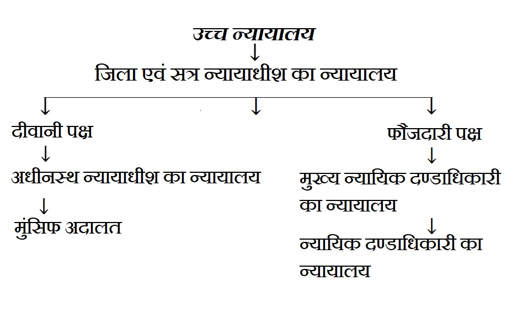
District or Sessions Judge
He is the highest judicial officer of the district.
When he hears 'civil cases' he is called 'District Judge'.
When he hears criminal cases, he is called a Sessions Judge.
He gets both judicial and administrative powers.
He can also give death penalty but it requires the consent/confirmation of the High Court.
Subordinate Judge
It functions below the District Court and hears only civil cases.
Chief Judicial Magistrate
It hears only criminal cases and can impose a prison sentence of up to 7 years.
It also functions at a lower level than the District Court.
munsif court
The lowest level court in the district which hears only civil cases.
magistrate's court
It is the lowest court in the district hearing only criminal cases.
It can lead to a prison sentence of up to three years.
Lok Adalat is a forum where the following cases can be brought -
-
Those cases which are pending in the court.
-
Cases which have not yet been brought before the Court.
The concept of Lok Adalat is very ancient but in independent India, it was first used in Gujarat in 1982.
Lok Adalats are based on Gandhian philosophy which suggests alternative resolution of disputes. Here disputes are resolved in the following ways -
- Conversation.
- Mediation.
- Reconciliation or agreement.
- Intuitive intelligence.
- Human approach to problems.
public court- Lok Adalats are also called Jan Adalats because it provides informal, cheap and quick justice to the common people.
legal status
‘Statutory Services Authority Act 1987By this, statutory status was given to Lok Adalats. The following provisions were made in this.
-
Lok Adalats have the same powers that 'Civil Courts' have under the Code of Civil Procedure.
-
The decision taken by Lok Adalat will be final and binding on all parties.
Benefit
There is no court fee of any kind in this. If the fees have been paid in the court but the case is settled by the Lok Adalat, then the fees deposited by the court is returned.
All parties can communicate directly with the judge through their lawyers.
Thus, Lok Adalats are helpful in providing justice free from technical complications in less time and less cost.
family Court
‘Family Court Act 1984' By 'family Court'Provision was made for establishment.
Objective
Creation of a specialized court that will deal only with family matters.
Resolving marriage and family related disputes expeditiously through mediation and negotiation.
Properties
The Family Court will be established by the State Government with the consent of the High Court.
A family court is mandatory for every city with a population of more than one lakh.
appeal
The decision of the Family Court can be appealed only in the concerned High Court, not anywhere else.
village court
**Village Court Act 2008 -**This Act provides for the establishment of a Gram Nyayalaya for every Panchayat.
Village Court Law Commissionis based on the recommendations of the114th reportI gave.
Birthplace of Village CourtsIt is Rajasthan only.
of RajasthanFirst Gram Nyayalaya at Bassi on 27th November, 2010Opened.
Objective
To make justice available to the poor and the resourceless at their doorstep so that they can get quick, cheap and appropriate justice.
Properties
The Gram Nyayalaya will be a mobile court which will exercise both civil and criminal powers.
Will emphasize the principles of mediation, conciliation and natural justice in resolving disputes.
The judicial officer will be appointed by the state government with the consent of the High Court. He presides over the Gram Nyayalaya.
Rajasthan High Court
of the constitutionArticle 214Inauguration of the first High Court of Rajasthan underMaharaja Sawai Mansingh of JaipurByAugust 29, 1949ToJodhpurWas done in. Chief JusticeKamalkant Verma(Former Chief Justice of Allahabad High Court and former Chief Justice of Udaipur High Court) and 11 other judges were administered the oath by Maharaja Mansingh.
First Chief Justice after the implementation of the ConstitutionShri Kailashnath WanchuWere.
Justice Shri Kailashnath Wanchu on the post of Chief Justicelongest tenureare. (1951-1958)
P. Satyanarayana Rao Committee(Members – P. Satyanarayana Rao, V. Vishwanathan, B.K. Gupta) On the recommendation of Jaipur branch of Rajasthan High Court, it was abolished in 1958.
Jaipur branch was again established in 1977.
Including the present Chief Justice of Rajasthan High Court50 judge posts approvedIs.
fact
In the year 2013, Brahmanand Sharma of Rajasthan became the first blind judge. Joined as Judicial Magistrate of Chittorgarh in January 2016.
Start Quiz!